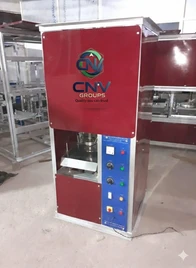
Single-die paper plate making machines are ideal for small-scale operations with limited space, while double-die machines offer higher production capacity for medium to large-scale businesses. The primary difference lies in the number of plates produced per cycle. Single-Die Paper Plate Making Machine DetailsSingle-die machines use a single mold to produce one paper plate per cycle. They are generally more compact and require less power, making them suitable for home-based or small-shop setups.
Production Capacity: Typically produces around 1,500 to 3,000 plates per hour.
Space & Power: Requires less space and consumes less electricity (around 1.5 kW to 2 kW power consumption).
Operation: Available in both semi-automatic (manual paper feeding) and fully automatic (automatic paper feeding, heating, pressing, and ejection) variants.
Material Compatibility: Handles a range of paper materials, including PE coated paper and paperboard, typically from 80 GSM to 500 GSM.
Double-Die Paper Plate Making Machine DetailsDouble-die machines are designed for greater efficiency, using two dies to produce two plates simultaneously per cycle. This results in significantly higher output and faster return on investment for commercial use.
Production Capacity: Can produce around 4,000 to 9,000 plates per hour, depending on the plate size and paper quality.
Space & Power: Requires more space than a single-die machine and uses slightly more power (around 2 kW to 3 kW).
Operation: Primarily fully automatic and often hydraulic, reducing the need for manual labor and ensuring stable performance.
Material Compatibility: Capable of handling a wide range of materials, including silver coated paper, aluminium foil paper, and heavy GSM paperboard (up to 500 GSM).